How can we watch an eclipse safely?
A total solar eclipse is headed our way August 21, 2017. Here’s what you need to watch it safely.
A total solar eclipse is headed our way August 21, 2017. Here’s what you need to watch it safely.
And it only took six months. Related Links: More Wordless Wednesday on Caterpickles “How does a storm glass work? Part One: The Pondering” (Caterpickles) “How…
The ability to explain complicated ideas in simple terms is a rare, but valuable skill. In Thing Explainer, Randall Munroe sets out to explain how complicated stuff like the microwave (food-heating radio box), the International Space Station (shared space house), and tectonic plates (the big flat rocks we live on) work using only the 1000 most commonly used words.
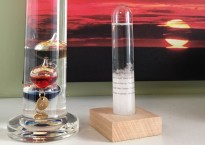
When The Ten-Year-Old first asked how Galileo thermometers work many moons ago, Daddyo knew the answer right away. Galileo thermometers operate on the principle that the density of a liquid changes with temperature, and that lower density objects float in higher density liquids. At first we surmised that each glass bubble held a liquid with slightly different densities. But it turns out the actual answer is much simpler than that.
Just after sunset tonight, glance up at the full moon. That bright star immediately next to it is Jupiter. Enjoy the view. Related Links: Top 7…
If you happen to live in an area where clouds and/or light pollution aren’t blocking your view of the sky (Chicago, I love you, but you do have…
This week, The Nine-Year-Old is reading Brown Girl Dreaming by Jacqueline Woodson and Women in Science by Rachel Ignotofsky. She also convinced me to hold a snake.
Our storm glass still isn’t back to normal. So I decided that this would be the week The Nine-Year-Old and I finally learned to use the Galileo thermometer Daddyo gave us all those years ago. Let’s start with the basics. What is a Galileo thermometer and how do you read it?
If you’re just joining us, yesterday we tried to reset our storm glass, with surprising results. 24 hours later, our storm glass is slowly returning to its old self.
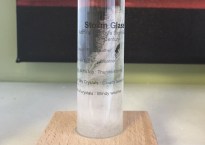
Last week, we tested our storm glass to see whether the crystals were forming (or dissolving) in response to changes in temperature. Short answer: Yes. At the end of the experiment we were left with a thick and long-lasting collection of grainy crystals at the bottom of the glass. We needed to reset it. But how do you reset a storm glass?
 CATERPICKLES