What to read, what to read?
My daughter is just beginning to be interested in books with more chapters than pictures. We’ve read Thornton Burgess’ Animal Stories together already and just finished…
My daughter is just beginning to be interested in books with more chapters than pictures. We’ve read Thornton Burgess’ Animal Stories together already and just finished…
The Important Book By Margaret Wise Brown Illustrated by Leonard Weisgard HarperTrophy, 1989 Age Range: 4-8 The important thing about this book is that it is…
From reading this blog you might think that my four-year-old daughter was simply obsessed with dinosaurs, but that is only because I have refrained from reporting most of her cat-related antics on the theory that the Internet already has enough cats. So when I found The Cat’s Pajamas in the bargain bin at my local bookstore, I was pretty sure I’d found a winner.
Boy, Were We Wrong about Dinosaurs! by Kathleen Kudlinski does a great job of showing how the theory of evolution applies to science itself. Strong hypotheses survive and multiply; weak ones die off.
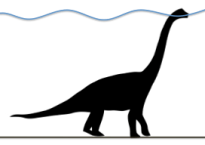
For one reason or another, we have a lot of old children’s books lying around our house. I was in the middle of reading one of these to my daughter over the weekend when she stopped me.
“Mommyo, why did they draw that dinosaur underwater?”
Laurence Anholt’s Stone Girl, Bone Girl tells the story of Mary Anning, an extraordinarily prolific fossil hunter born in England in 1799.
Reading Prehistoric Actual Size to my daughter, I found myself placing my hands on the page very carefully, lest I snag my finger on a Baryonyx claw or accidentally touch the Very Large Cockroach. It’s not that the illustrations are so terribly life-like. They are clearly pictures. It’s just that the effect of seeing these creatures, or in most cases, bits of these creatures, at actual size is so startling.
In 1853, almost no one knew what a dinosaur looked like. No one had ever mounted a complete dinosaur skeleton, and who could imagine what these strange creatures would have looked like with muscles, skin, teeth, eyes, tails, and feet all in their proper places from just a heap of bones? In the Dinosaurs of Waterhouse Hawkins, Barbara Kerley tells the story of the Victorian artist who, with the help of renowned scientist Richard Owen, brought dinosaurs to life for the people around him.
Of all the dinosaur books my daughter and I have read so far, Lenny Hort’s Did Dinosaurs Eat Pizza?: Mysteries Science Hasn’t Solved may be our favorite. It packs a lot of information into very readable bursts of text.
 CATERPICKLES